AirGradient Forum

They Add More Pollutants; We Add More Accuracy. Why We're Stepping Back from PM<sub>1</sub> and PM<sub>10</sub> Marketing

I’ve been thinking a lot about something that’s been bugging me in the air quality monitoring world for some time. It feels like there’s this race happening, a rush to see who can cram the most pollutant measurements into a single device. “The new 14-in-1 air quality monitor!” the headlines shout. At first glance, you might think, “Wow, that’s comprehensive!” But here at AirGradient, we’ve always believed in something different: honesty, accuracy, and giving you real value. That’s what really matters.


This is a companion discussion topic for the original entry at https://www.airgradient.com/blog/they-add-more-pollutants-we-add-more-accuracy/

Hey Achim and team,

It is really hard these days to find companies that are genuinely trying to do a great job and are trying to create the highest quality while balancing the challenges of business life. Integrity is key and is usually the first thing that goes out the window when corners need to be cut. I highly appreciate that you chose the high road ad you are committed to build quality and protect the integrity of both of your product and your team.

I have just run into AirGradient relative recently. Read 2 newsletters and have been to one of your webinars, but I have to say it really feels nice to run into some great company in the process of learning about safeguarding clean air and helping others understand why this topic is important.

Keep up the great work.

Also the blog posts. I have saved about 80% of the links I got from you so far, for further reference later or to be able to send to other people easy to consume resources on this highly complicated topic.

The work you are doing with schools, the UN, LA and all across the board is very inspiring.

This reply turned into a general acknowledgement. It had to be said.

However, I do feel the struggle of buying the right monitors and how to address sensor quality as an end user.

Not only buying but maintenance is also in question.

I have 2 PM2.5 sensors like the ones you use and just got an Atmo tube. I was considering buying all kits available on the market (there are a few these days) to see the distribution of data I get, but it feels like an uphill battle without lab level equipment to test them.

I would love to know if you have some recommendation on sensor maintenance or if you considered something along these lines for your product too.

Even if I buy the assembled kit from you, I am not sure how and when that should be looked at to make sure the readings stay accurate.

Would love to hear your thoughts on this.

Keep up the great work,

Timea
Thank you for your nice words. It’s good to see that the way we want to be really shines through.

Yes, it’s sometimes hard to not cut corners and things need more time but I strongly believe that in the end transparency always wins.

Regarding finding a good air quality monitor, I strongly recommend below blog post we wrote some time ago.

Typically the monitors are maintenance free and probably the only sensor module with a somewhat limited lifetime is the PM module.

Regarding accuracy we are working on some interesting features that would allow background calibrations which will be rolled out in the next few months.

It seems the PM1 and PM10 options are no longer available under Advanced Configuration (2026-03-19). Am I missing something, or have they been removed?

No, they should still be available. If you don’t see them, please contact our customer support via our website.

I can’t find this either. Did you find it?

Hi @Stanislav_Modrak - could you write us via Contact Us form here: https://www.airgradient.com/support/ - we’ll have a look!

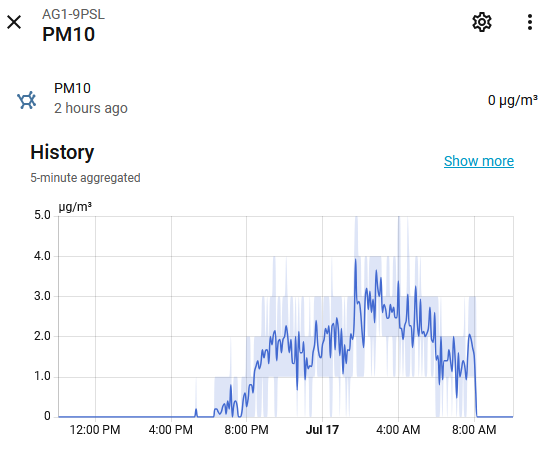
I have an AirGradient ONE (I-9PSL). The PM1 and PM10 readings have always been and remain 0 (zero). The AirGradient does not provide any PM1 or PM10 values. The PM2.5 readings on the AirGradient are roughly inline with another particle detector that I have using a similar Plantower sensor. (Had to calibrate the AirGradient to provide a signal at the very low end or it would just sit at zero.) I have limited funds to purchase air quality monitors but was forced to buy the AirGradient to track PM2.5 over time to chase down a second-hand smoke issue. (Had to set up home assistant just to connect to and track the AirGradient PM2.5 levels.)

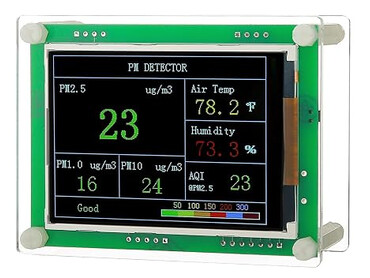
I can recommend the relatively inexpensive air quality monitor from China via Amazon HOTKREM Air Quality Monitor pm2.5 pm10 pm1.0 Detector Indoor air Quality Test kit for Cars ,Home,Office,Hotel etc (PM2.5,AQI): Amazon.com: Industrial & Scientific . This HOTKREM monitor looks like nothing more than the plantower sensor attached to a small display. It has three advantages: (1) runs on a 5V external power supply so it is portable when used with a portable phone charging brick. (2) The sensor reacts quickly and the readout is in ug/m3. (Ignore the AQI as it uses the Chinese algorithm.) (3) The HOTKREM monitor provides what seem to be more reliable PM1 and PM10 levels.

AQ monitor

Also ignore the Humidity readings as they are always way too high.

Anyway, if it is true that the Plantower sensor does not provide accurate PM1 and PM10 readings then AirGradient should just remove them entirely. I have not used them since they are always zero. But it makes me wonder if the PM2.5 readings are accurate?

Hi @Buzzer, have you tried applying the PM2.5 correction algorithm in case you have a DIY-Kit? It should help with the zero reading you’re experiencing. If you have a fully assembled unit, please feel free to contact us.

These two articles could be helpful:

https://www.airgradient.com/documentation/kb/kb-diy-enhance-the-accuracy-of-the-pms-sensors

https://www.airgradient.com/documentation/kb/pm-batch-correction-factors

With appropriate corrections on a new(ish) sensor:

{
“pm01”: 123.17,
“pm02”: 278,
“pm10”: 299.33,
“pm01Standard”: 185.5,
“pm02Standard”: 417.83,
“pm10Standard”: 449.67,
“pm003Count”: 9464.5,
“pm005Count”: 8958.17,
“pm01Count”: 3267.83,
“pm02Count”: 463.33,
“atmp”: 20.5,
“atmpCompensated”: 19.1,
“rhum”: 69.17,
“rhumCompensated”: 94.42,
“pm02Compensated”: 263.11,
“rco2”: 503,
“tvocIndex”: 117,
“tvocRaw”: 32163.42,
“noxIndex”: 2,
“noxRaw”: 20476.08,
“boot”: 25444,
“bootCount”: 25444,
“wifi”: -75,
“serialno”: “d83bda1e1e94”,
“firmware”: “3.6.2”,
“model”: “O-1PST”
}

They def report, just not at low levels.

AirGradient does seem to have some data on PM10, it is just pegged at zero a great deal of the time. PM2.5 was also often pegged at zero until the corrections were applied. The corrections have lifted the baseline of the PM2.5 readings so that low readings are non-zero. While they may not be accurate in an absolute sense, for the low values I am mostly watching the numbers for changes. It’s OK. PM10 does not seem to work as it stays at zero too often.
image

Yes, tadawson: I agree

I’m glad to hear the correction works. Currently, our main focus is PM2.5, so the correction algorithm you apply will only affect PM2.5 readings (output as pm02Compensated).