I recently got the Air Max and the TVOC and NOx readings are extremely high. In the thousands!
I thought it would correct its after a few days but it doesn’t. What can I do?
The way the Max works with a deep power saving sleep it can’t currently provide the standard Index value so it is showing a raw reading.
So it is behaving the best it can and AirGradient has been aware of it but hasn’t found a better solution or done a better job of communicating this
Thanks for the information. Is there a formula to convert the values to an index manually?
Not that I’m aware of. Typically the sensor needs around 90 seconds to fully initialize and get baseline information before it would start providing proper index values.
The Max only wakes up for a few seconds to get readings and then goes into a deep sleep so the SGP40 never gets a chance to fully setup, resulting in AirGradient only sending the raw values before it goes to sleep.
hawi1204, this paper from Sensirion describes their TVOC/NOx sensor and how that data is treated.
The SGP4x series is intended to be an indoor sensor package. It was not designed for nor intended to be used as an outdoor TVOC/NOx sensor by Sensirion. The gas mixture that it is calibrated against are all indoor air pollutants identified by a Danish researcher in the early 1980’s. Those gases were likely commonly found indoors 40 years ago from their sources, which were commonly found indoors, at least in Denmark. The methodology described in his paper, the third reference on page 7 of 11 in that document, describes a process of identifying physical effects of subject’s exposure to those gases under tightly controlled conditions. That paper is locked behind a paywall but I did find the list of gases used to calibrate these sensors.
The SGP4x series responds to a variety of gases since it is a metal oxide sensor, MOX sensor. The treated substrate becomes more or less resistive in the presence of oxidizing or reducing gases and that creates the data stream for TVOC and NOx. It is non-specific in that it cannot be used to identify a specific gas in the air column it samples but it does respond near instantaneously to changes in those gaseous components.
A couple of papers from Sensirion about gases:
The TVOC and NOx data stream is presented as either raw ticks or post-processed data with a time-averaged time series. If the unit is cycled and the time series does not have a complete data stream then the time averaging will break. (That may not be relevant for your unit as I am not familiar with the Air Max product). I believe the two periods in use are 12 hours (1/2 day) and 720 hours (30 days). This provides a short-term average response that helps the user understand whether TVOC/NOx is varying in the near term window. In my opinion there is near zero value for the 720 hour time averaging window since that level of smoothing will tend towards a flat line with lowered ability to identify current events. I could be wrong about that but I am working on understanding the effects from my own sensor now. I have a 0-1PST outdoor unit and about 18 months of data. The TVOC/NOx response clearly shows a learning period followed by a general flat-lining over the long term.
If the Sensirion SGP4x TVOC/NOx sensor is not intended to be used for outdoor air monitoring then why was it chosen for this application by Air Gradient? You may be asking this question.
Luckily, Achim has already answered that question for us. Here is a link to that blog post:
The answer to your question comes in the section - Air Quality Certifications, new Sensor technologies…
In summary, there was a need for their monitors to be RESET certified and that certification requires that the monitors be able to measure TVOC. At the same time Sensirion and Bosch developed upgraded sensors, the SGP4x line for Sensirion, that reported levels based on a calibrated index measure. Those calibrations are documented for the sensors in the paper above. Thirdly, they recognized the value of monitoring relative changes in gas concentrations over time and these sensors could provide that type of data value.
I do not agree that there is much value in using an SGP4x sensor in an outdoor package because the changes that it detects are non-specific to any gases, hazardous or non-hazardous and there is no way for the user to determine from the data whether a critical event has occurred and what action they should take. These sensors would be useful in an outdoor context if they were paired with traditional weather station data so that a user could understand whether a significant increase had become an actionable event and, using the weather station data, which direction they should move in order to avoid the highest danger from the detected gases.
There is no wind data available in any Air Gradient product. You are getting a simple point data stream with no context that would assist in understanding potential sources of the detected gases. If you are indoors, the sources are probably easier to identify. Outdoors is a different world entirely. Pairing your Air Gradient with a local weather station can provide this context so if you have Home Assistant and a weather station with wind speed and direction data and you pair your Air Gradient to Home Assistant then you can more reliably assess the situation and any risks.
I do understand why the sensor was chosen though in the context of meeting the required specs for air quality monitors. Sometimes you do something because someone decided it had to be done that way even when they know it is unnecessary and likely creates confusion.
Here are few other papers from Sensirion that may help you understand the sensor operation and how it is handled:
Note that the link at the end of the last paper on NOx index is circular (What is Sensirion’s NOx Index?). It takes you to that exact same document so maybe someone can poke the Sensirion people and have them check and correct that document.
Have fun. I am doing a bit of a deep dive right now so that I can make best use of the various data streams from my O-1PST unit. I’m no expert but I am reading and learning.
1 Like
Achim here. Super interesting discussion.
I am just traveling around Hong Kong but below article contains TVOC measurements outdoors against a reference station in Switzerland.
So I believe there is some use to it but needs a lot of interpretation.
1 Like
Achim, thanks for reading that wall of text. I am walking through the various documentation and will be posting comments on that exact discussion as soon as I organize them a bit. I agree that there is some use for it indoors and possibly outdoors but you definitely need to understand limitations before you attempt to use it qualitatively. There’s a lot to talk about and I will post when I get it ready so that everyone can read the comments and and documents and learn in the process. Have fun in Hong Kong. It will probably take me a couple of days.
1 Like
@Flatspot just to clarify, the comparison in above article with the TVOC reference has been done outdoors. I am refering to this chart:
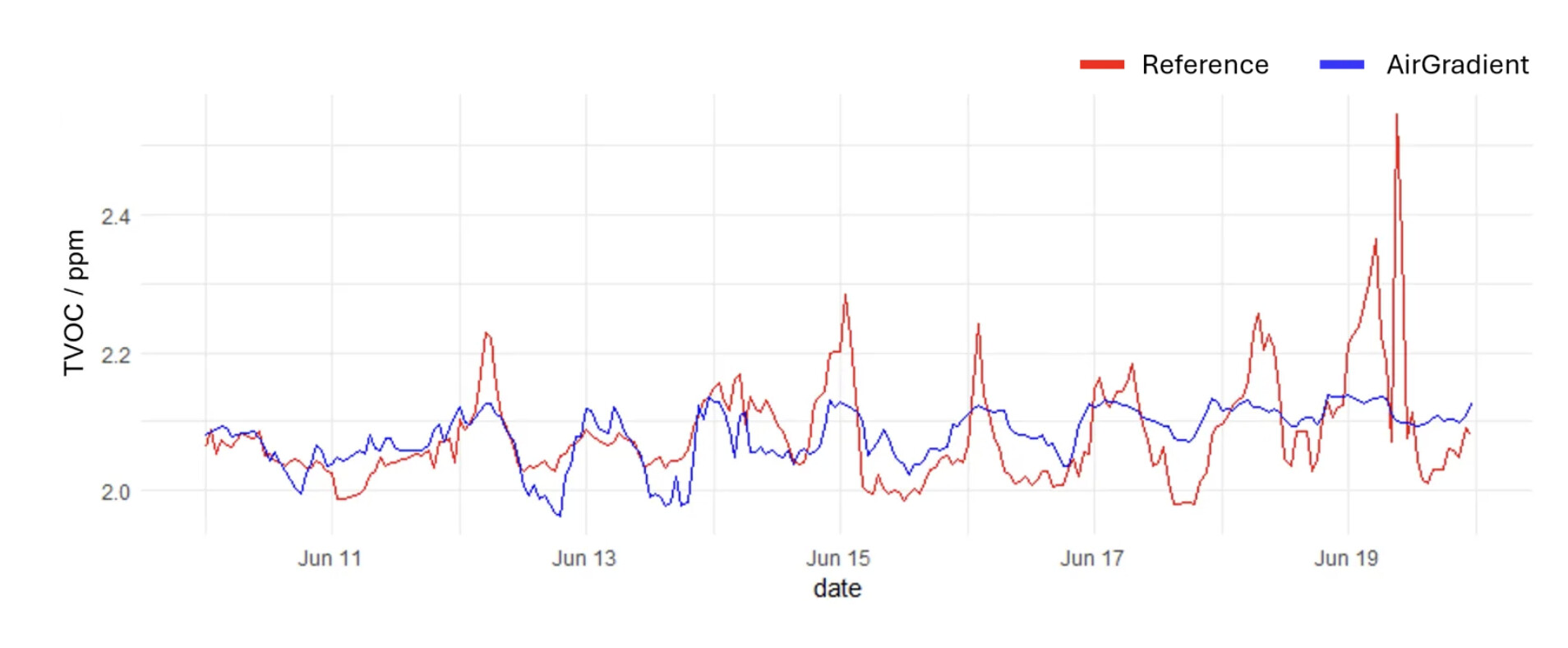
I think we are on the same page regarding the strong limitations of measuring TVOCs. I basically have a love/hate relationship with it. We once detected with the TVOC measurements a pot of glue forgotten in an A/C duct in a classroom -which was definitely not healthy for the kids. On the other hand you have tons of spikes you can basically not explain at all.
What we try to do at AirGradient is to be 100% transparent about what we thing, what we know, and what we discover and learn.
Recently we took a deep dive on the NOx signal of the same chip (SGP41) and results are extremely different between indoors and outdoors.
Outdoors if fails: Why the SGP41 Can't Measure Ambient NOx
Indoors it’s not that bad: The SGP41 Detects NOx Events, But Can You Trust the Number?
Hi @hawi1204 - just to chime in here on the original question. We’ve recently implemented the conversion from raw to TVOC index on the Maxes. This is documented here: How We Implemented the TVOC Index to the Open Air Max
This will be available in the new firmware version 0.10.0
I agree with @MallocArray here that we haven’t done a good job of communicating this. We didn’t expect it would take this long to implement this but that’s not an excuse.
1 Like
That’s great news. Is 0.10.0 available already? When I go to the Firmware Upgrade page it shows AirGradient Open Air MAX 0.5.1, while the current FW on my Air MAX is 0.9.1.
Also made a dashboard which still needs some refinement.
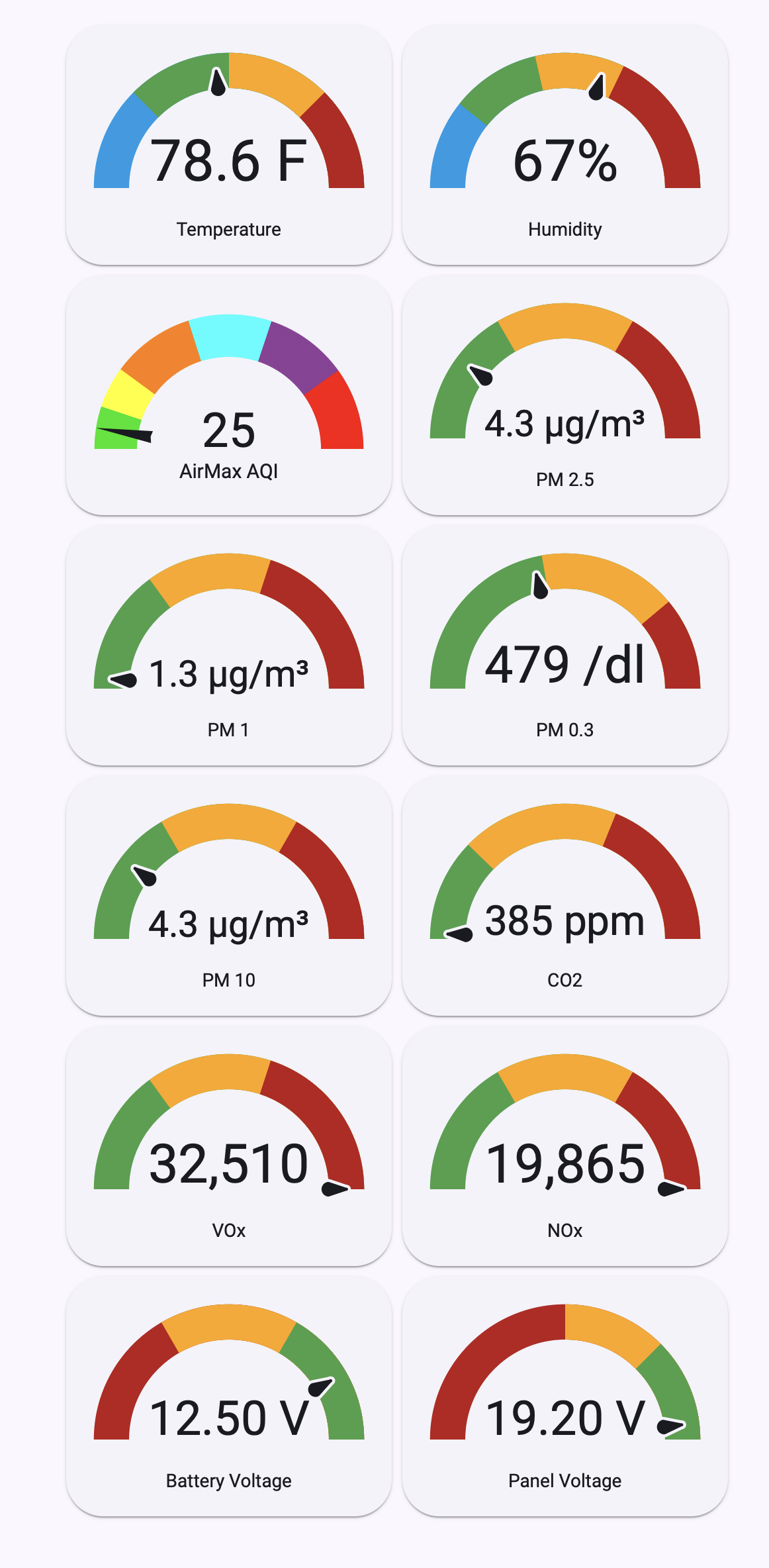
EDIT: Sorry, this was supposed to go to another thread where I posted how to expose Air MAX data in Home assistant
Hi @hawi1204, the FW 0.10.0 for Open Air Max is still in the testing process.
Only AirGradient staff can see the unreleased version in the dashboard’s firmware settings. But we can also make a whitelist for users, so their Dashboard can be set the target firmware to an unreleased version if they are interested in trying.
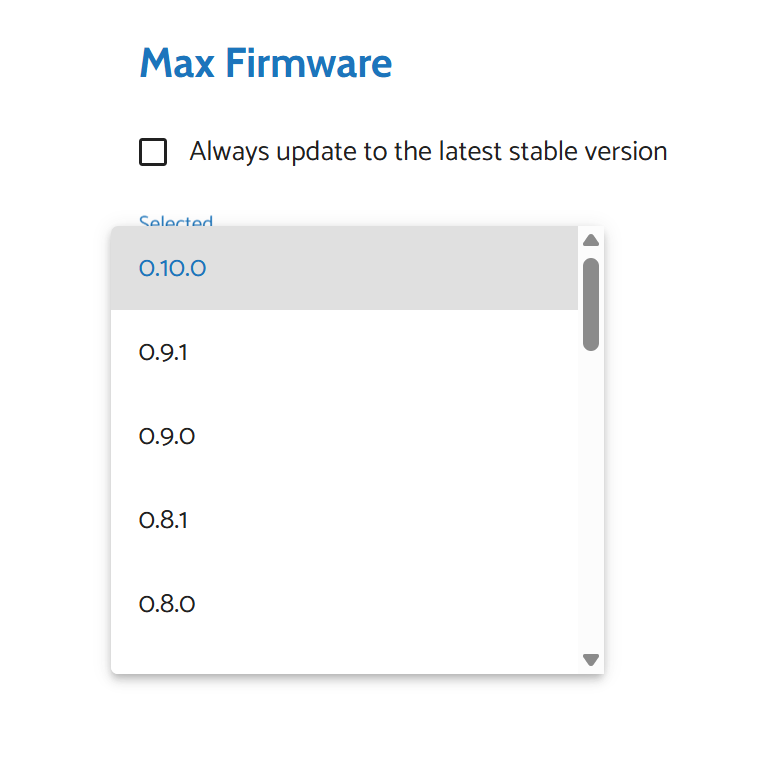
For a deeper deatils about the FW 0.10.0, you can see here: Release 0.10.0 · Open-Air-Foundation/firmware-openair-max · GitHub
Interesting, I wasn’t aware that 0.9.1 is also an un-released version.
I am willing to beta-test 0.10.0. Would downgrading to 0.9.1 be possible if things go sideways?
Hi @hawi1204 - I’ve been testing 0.10.0 for while now. Haven’t run into any issues but yes downgrading is always possible. You can email me your PlaceID at altair.irfan@airgradient.com - I’ll enable it for your dashboard.
1 Like
Thanks Altair, that sounds good. I’ll email my location ID
1 Like
Thank you for your interest in the new firmware. Please feel free to report any issues to us!
Thanks Tai, it’s working great so far. I’ll report any anomalies here.
1 Like
I think we are on the same page regarding the strong limitations of measuring TVOCs. I basically have a love/hate relationship with it.
I can agree with this. There’s a lot going on and the sensors themselves have limitations. You have documented those issues well.
What we try to do at AirGradient is to be 100% transparent about what we thing, what we know, and what we discover and learn.
I know that I appreciate this. The data should tell the story and AG attempts to lay it out so that others can follow the data.
I have been back and forth through AG’s documentation. I appreciate the depth of the processes. If I have any questions about something I will ask so others can learn too.
Thanks Achim.
1 Like