AirGradient Forum

Max reportable AQI? (Contaminated by irrelevant spew . . . perhaps don't read . . . )

@tadawson, my very pleasure. Please stay safe!

Regarding your HA Helper (sub 500 AQI), I wonder if it reports a lower AQI value than what you see on the AirGradient ONE’s OLED display itself? Maybe we can try to investigate how your Helper works and find a way to make them better align.

Hard to say, since the one I have multiple comparible points for is my outdoor (no display), although HA does report both. I’ll try to dig up where I found the helped, since I don’t recall it being mine.

OK, looked more . . . The helper appears to track the EPA formulas well, although the breakpoints in use are tracked by some sites, and are different elsewhere, so not sure if I am on the right ones.

Another question is which input value to use? PM02, PM02Standard, or PM02Compensated?

PM02Standard is the highest off the monitor (PM02 is currently being used in the Helper) and readings are still a tad low in HA vs the dash, so clearly we are not running the same values (although I now seem to recall getting the AQI calc from this forum . . . further supported by the Helper having a cap at 500 as initially deployed, which also likely explains the high error at high smoke levels.)

For fun, I have altered the Helper to add a range from 500 to 1000, and if things get that bad here, I’ll see what I get.

(Clearly the PM count is only bounded by when the air becomes a liquid or a solid, so nothing would appear to invalidate a linear scale . . . )
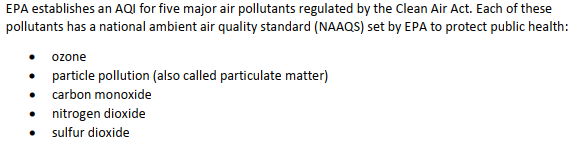

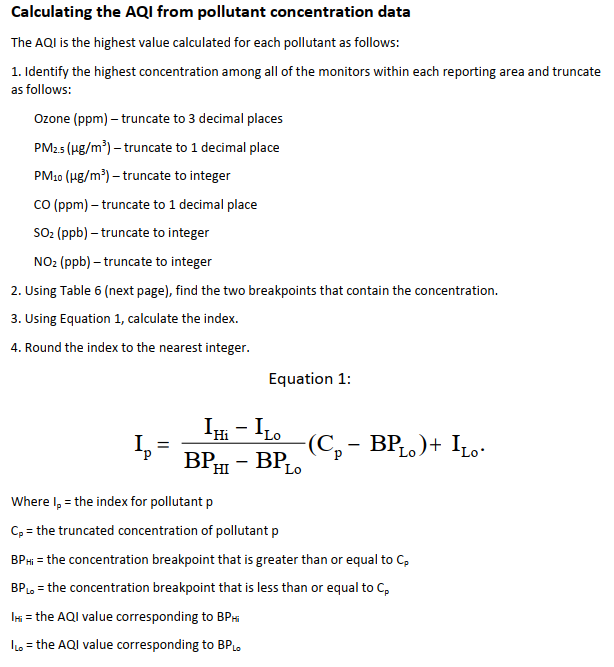
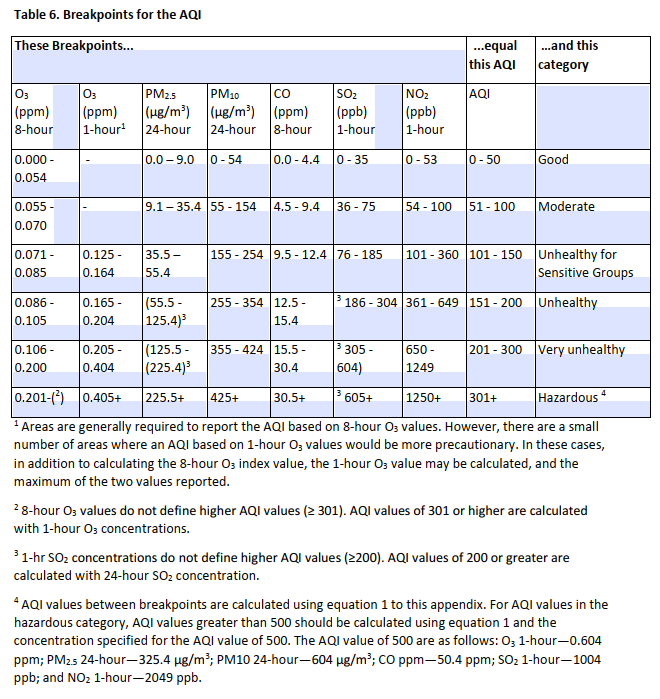
Tal, thank you for posting the link to the EPA document on the AQI calculation. As you can see there are 5 pollutants that go into the calculation.
image
The AirGradient device only measures one-half of one of them - PM2.5 - since PM10 readings from AirGradient are not accurate. The AirGradient device (and likely most other consumer devices) do not have accurate sensors for measuring ozone, carbon monoxide, nitrogen dioxide and sulfur dioxide.
Ipso Facto the AirGradient device cannot provide an AQI.

Note the time averages used for the differrent pollutants in the calculation of the AQI.


For PM2.5 this is a 24-hr average. Instantaneous measurements of PM2.5 cannot be used to calculate an AQI until they are averaged over a 24-hour period. Of couse one could assume that the current reading or a short-time average would remain the same for 24-hours but this is usually not the case for rapidly changing conditions like wildfires. This may be why the AirNow 24-hour averaged AQI values are not very helpful in helping to see if the AirGradient device is accurate.

But yet, damn near every online reporting site (US at least) seems to report realtime data . . . .

Let’s not confuse this issue with things that do not appear to be happening in reality.

In a word, nonsense!

US AQI is defined as the highest value of that list - NOT a combination. Thus, what is reported darn near everywhere as AQI(pm2.5) is the specific particulate figure, which is not confused by this nonsense, and which AG is already reporting (and tracking official sites quite well, further disproving your claim).

Most interesting is the actual calculation of the AQI from the measured values. It seems that the highest value is used and not the time average over the given period as I had previously and erroneously assumed. This is odd. A brief spike in PM2.5 would result in a very high AQI


Although not a difficult calculation to make, my point here is that the AQI is very far removed from the instantaneous or short-time average of the PM2.5 level that is provided by the AirGradient device. I conclude that AirGradient should NOT report any kind of AQI value as it is misleading. Those devices that translate the levels measured by low cost sensors into AQI values (or colors) are deceptive.

Perhaps I am wrong about this, but please address these concerns and don’t just ignore them or proceed as if they did not exist.

Aaaaand those are the very conditions that we are seeing here with the Canadian smoke. AQI (all reporting sites) can move by a couple of hundred points inside an hour, depending on the plume. While long term data has value for overall conditions, it is useless for situations like this . . .

And I CONTINUE to note that my AG is consistently within a few digits of the “official” figures here (except when over 500 . . . THE thread topc . . . ) completely negating this absurd claim.

So, at least based on my observations with real data in severe conditions, you are COMPLETELY wrong on this!

The AG DOES basically face-plant with the newer sensors in low particulate conditions, but (my unit(s) at least) appear to be very accurate under severe ones.

tadawson, sorry to have upset you. As I said I have been confused by the AQI because the numbers reported by various sources do not match.

Perhaps you are missing my point. AQI is an odd calculation, taking a measured value in ug/m3 and turning it into something else entirely. I am simply saying that consumer devices like the AirGradient cannot be used to calculate an AQI the way the government agencies do. So just use the PM2.5 ug/m3 values that the AirGradient provides and ignore any translation into some local and deceptive AQI. AirVisual (IQAir) seems to provide a PM2.5 value in ug/m3 that closely tracks what I see with AirGradient in my location. Your outdoor monitor flatlined at 500. Does this mean that the PM2.5 ug/m3 number from the AirGradient flatlined? If so you are really in deep smoke and I am very sorry. If not then you can use the measured PM2.5 in ug/m3 to understand what is happening in real time.

This is wrong! I erronously assumed that the PM2.5 24-hour period would be an average. Instead the AQI is calculated from the highest value in 24 hours. This seems odd, but it is a government agency. Anyway, to get an AQI you must look back at the past 24 hours and use the highest value.

And I am practically screaming, that when I am within afew percent of the official sites, facts tend to nullify that claim.

The math for AQI is trivial, as are the conditions to use it. And it really isn’t a transformitive value, but more of a normalization as I see it.

The 500 apears to be an AG software cap in the dashboard, nothing more.

And AQI (as I see it reported by EPA sites) is clearly NOT your "highest in 24 hours bs! We hit 1000 yesterday mid afternoon, and with a wind shift an hour or two later, dropped to the 400’s . . . (as reported by all sites) which would have been impossible if your claim had any merit or accuracy whatsoever!

And please keep this crap OUT of my thread! Thetopic was why the cap at 500, period!

It is now contaminated with loads of unrelated noise!

Start your own thread if you want to keep beating your drum!

image

Again sorry to disturb you tadawson. I like the AirGradient device and find it useful, I hope you do too. My posts directly address your topic: why the cap at 500? Because you are looking at the wrong number! Use ug/m3 and ignore AQI

Again, STOP THE BULL$H!T!!!

AQI is valid (and reported by), apparently, for everyone but YOU! (An observation that I could care less about!)

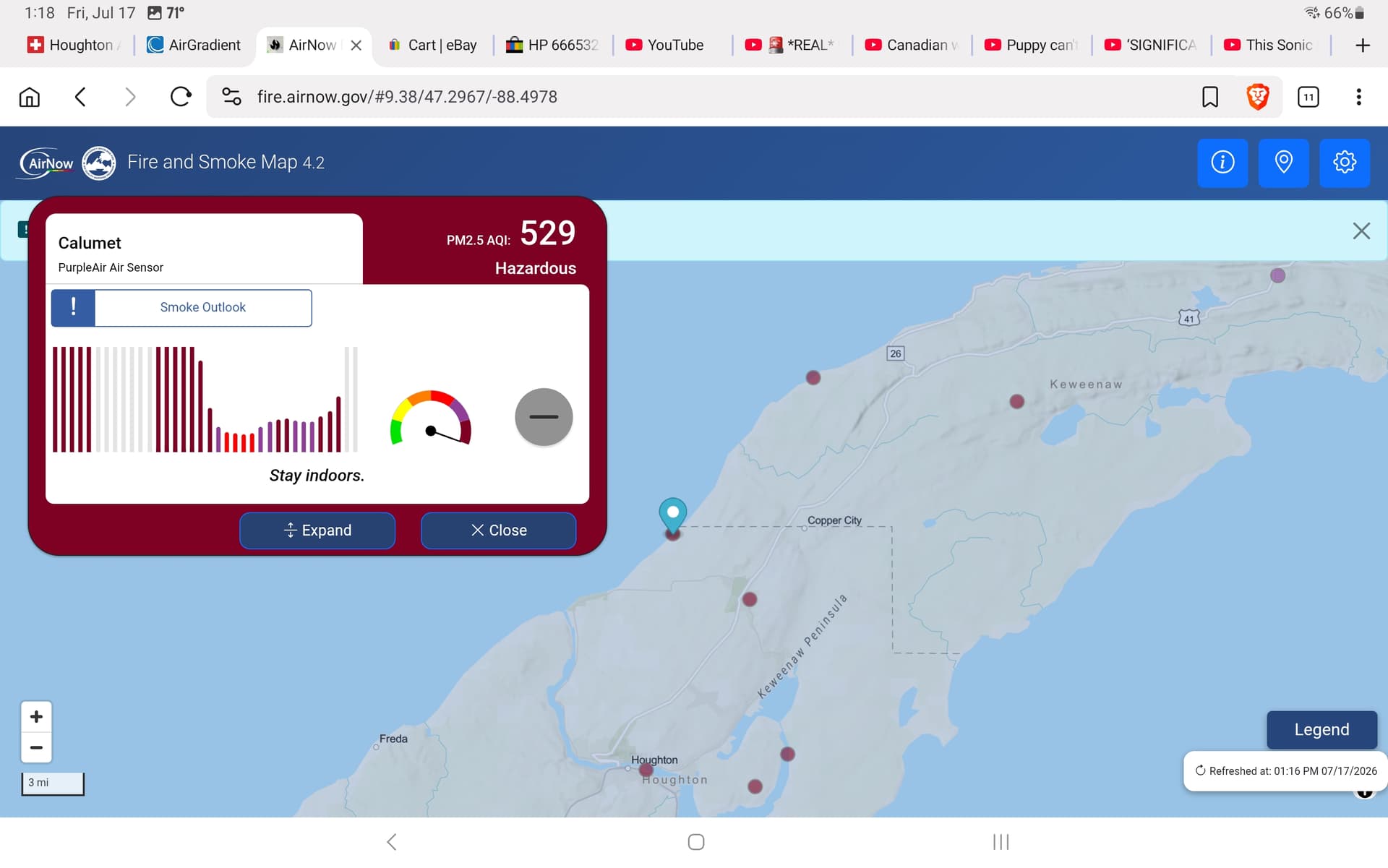
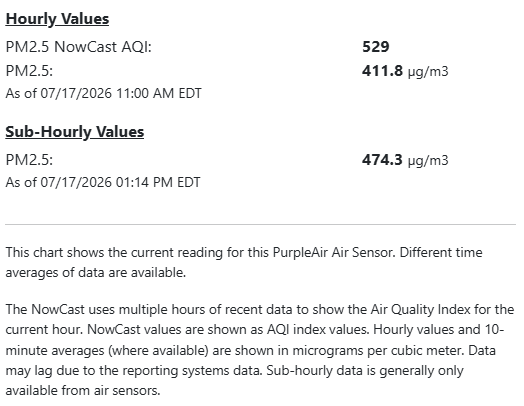
(The US EPA and Forest Service official site sure seems to be onboard with AQI and above 500 . . .

image

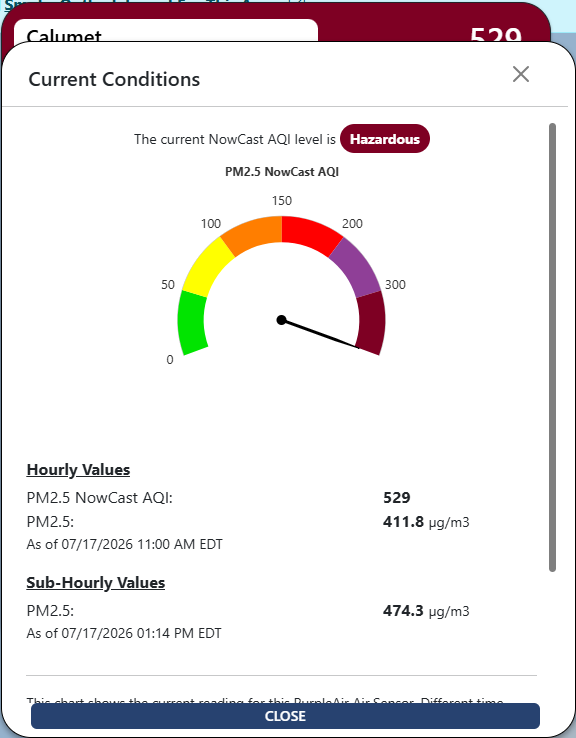
Your AirGradient reads in ug/m3 and AirNow also reports the hourly and 10-minute averages in ug/m3. The AQI meter is pegged.

Read the header dingus! 529! I could care less about the “cutesy meter”!

Mods: Please close and delete this thread - this twit won’t stop spamming it!