Do you mean your Open Air reports 4,000 degrees off if no correction is applied?
What? It 4 kelvin off … it same as 4 degree celsius… lol
No it of with correction applied…
Let me just jump in here with a few thoughts and comments:
-
Too all involved, please keep this conversation constructive. We want to improve the product but this is only possible if every side feel appreciated.
-
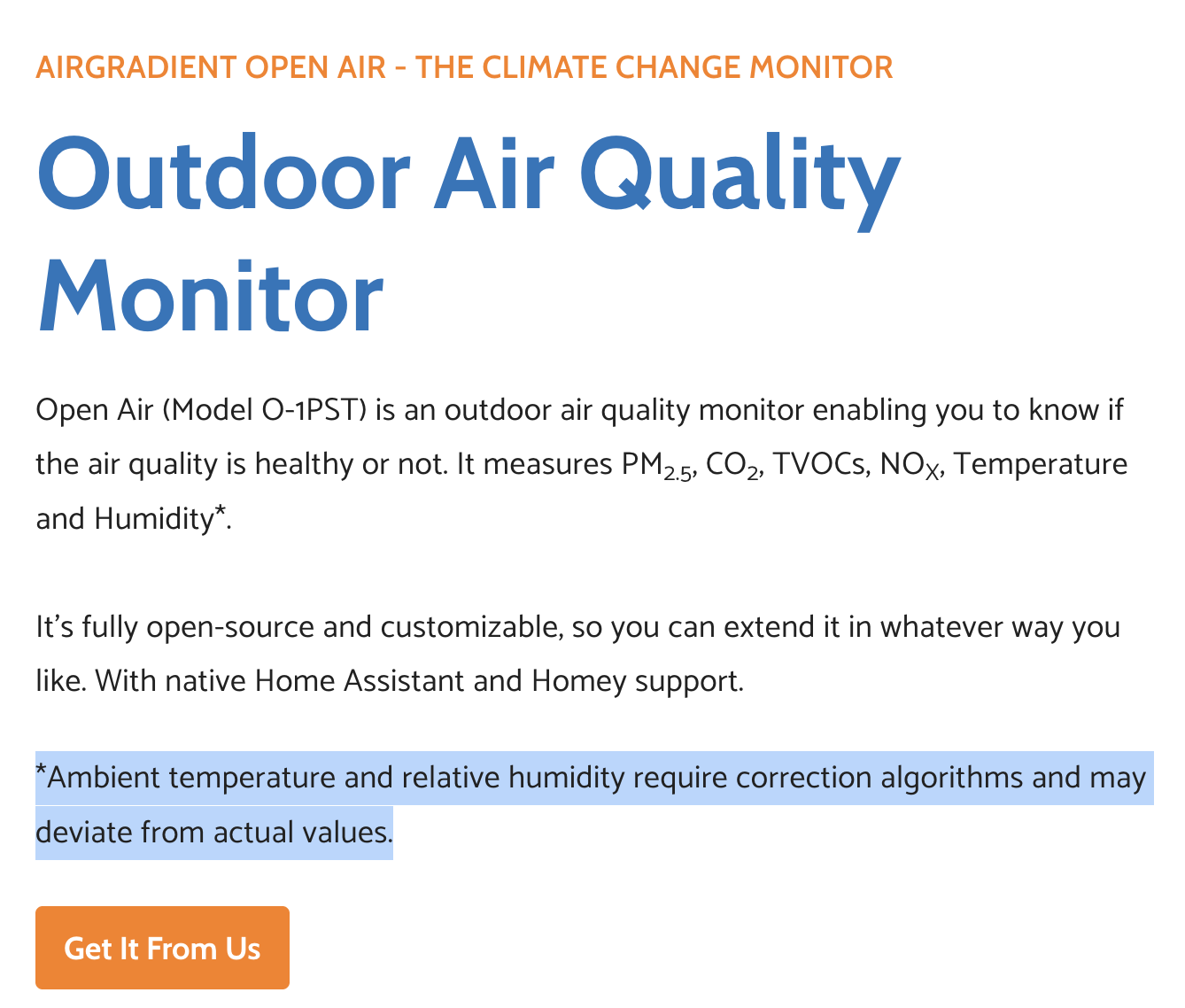
We are extremely upfront on the temperature issue on our product page. Here is a screenshot that details exactly that the temperature measurements should not be takes as ambient levels:
-
We have investigated the temperature and humidity issue indepth 2 years ago, and Anika our science lead did actually a whole webinar on it. Presentation is here: https://www.airgradient.com/documents/webinars/AirGradient_Webinar_Temperature_and_RH_Correction_MAR2024.pdf. So we take this issue very seriously.
-
There are a lot of factors impacting the temperature and humidity, external factors like sun exposure, wind, but also possibly firmware updates. And the enclosure design of the units probably poses most limitations. I think we can consider an external probe for a future update of the Open Air which might be best solution but would make installation slightly more complex and some people might not like the looks?
2 Likes
I just received the indoor and outdoor sensors and the outdoor is reporting higher values of temp/humidity and lower values of Co2. They are a foot apart from each other inside while setting up for the first time. This is unacceptable. Govee hydrometers are all within 1-3 difference for temp and humidity.
The inside one reads 74 degrees f and 50 percent humidity
The outdoor sensor reads 80 degrees and 60 humidity
Hi @Danny_Lee, welcome to our community!
For the temperature and humidity in the outdoor unit (Open Air), it is primarily used to improve the accuracy of PM readings. It may deviate from the ambient temperature as @Achim_AirGradient mentioned above.
Regarding the CO2 reading, to make sure that both establish a similar baseline. You can take both indoor (AirGradient ONE) and outdoor (Open Air) outside, where you have fresh outdoor air, then manually calibrate their CO2 sensors. You can connect both air monitors to a power bank if an electrical outlet is difficult to reach.
Here’s the guide for manual CO2 calibration: Carbon Dioxide (CO2) Sensor Calibration Guide | AirGradient Knowledge Base
Please let me know if there’s anything else I can help.
I do not have a reference device to compare against, but my Outdoor Airgradient (Model: O-1PP, firmware 3.7.0) consistently reports much higher temperatures than the “official” temperature.
Currently, it’s displaying 13.9C whereas the official temp is 9.4C, i.e. my device is showing 4.5C higher. The temp calibration is already set to “Standard AirGradient Open Air Calibration”. The unit has always been in a shaded, well ventilated area.
I have thought about applying a fixed correction number (e.g. -4 celsius) but I wonder if that’s actually helping things or just adding another layer of unreliability. Perhaps the best option going forward is to ignore the AirGradient temperature reading altogether and instead rely on the “official” temperature.
Hi @prouser! Thanks for sharing your observations. The issue is that the Open Air does not have a dedicated temperature and humidity sensor. Instead, it uses the temperature and humidity sensor integrated into the Plantower PMS5003T sensor. These measurements are intended to support correction of the particulate matter measurements for research use rather than provide precise ambient temperature and humidity readings.
We initially made these readings available at the request of customers, with the understanding that they came with certain limitations. Because the sensor is located inside the monitor’s enclosure, it is not directly exposed to ambient air. This means the temperature readings can be affected by conditions inside the enclosure.
Unfortunately, it seems this important limitation has become less clear over the years, and I’m sorry for any confusion.
Interestingly, whenever we’ve considered removing or hiding these readings, customers have generally preferred that we keep them available because they can still be useful for tracking trends and relative changes over time.
The “Standard AirGradient Open Air Calibration” helps compensate for these effects to some extent, but it cannot does not provide accurate ambient temperature and humidity measurements under all conditions.
I hope this helps clarify the limitations and the reasoning behind making these readings available.