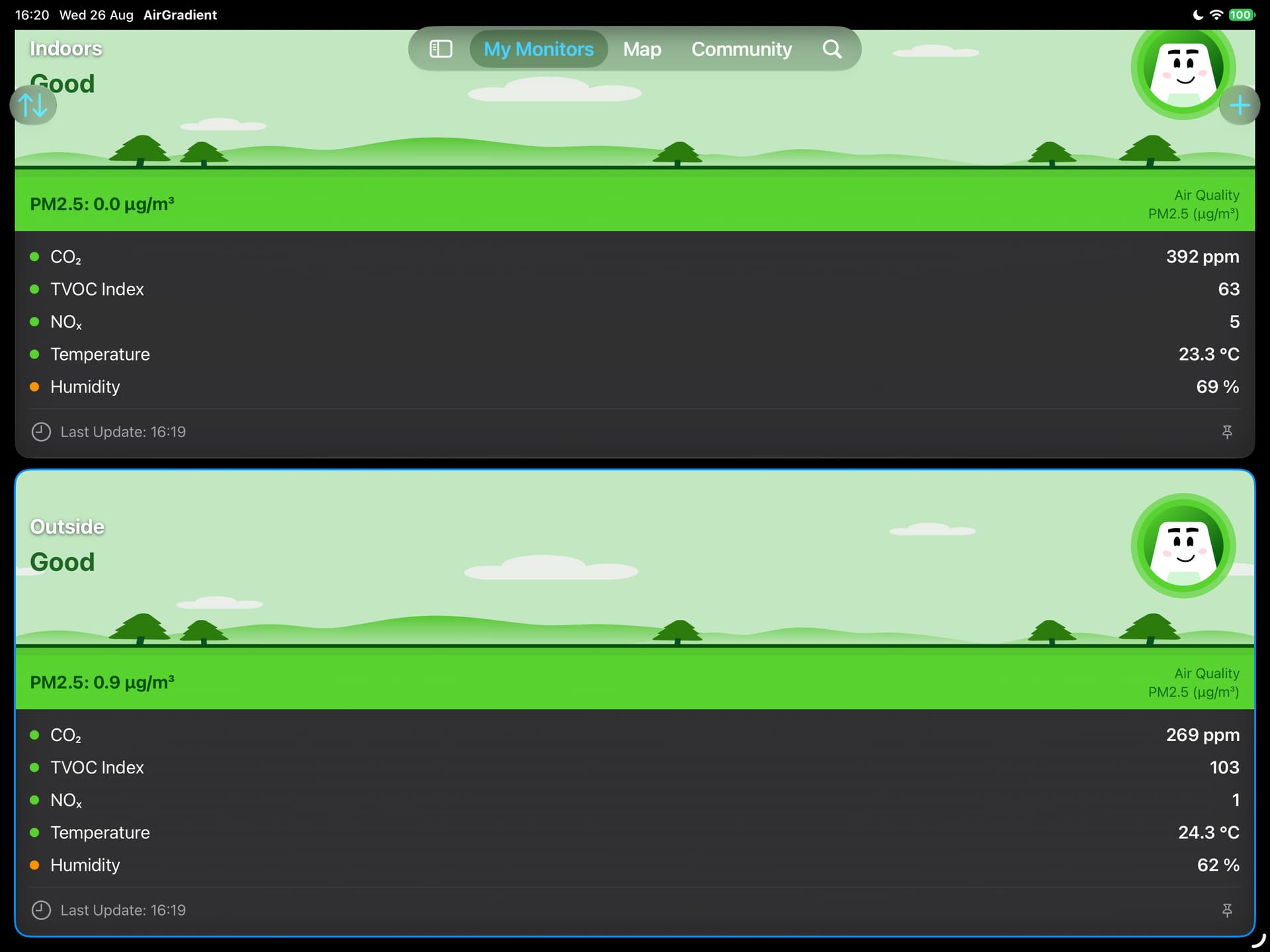
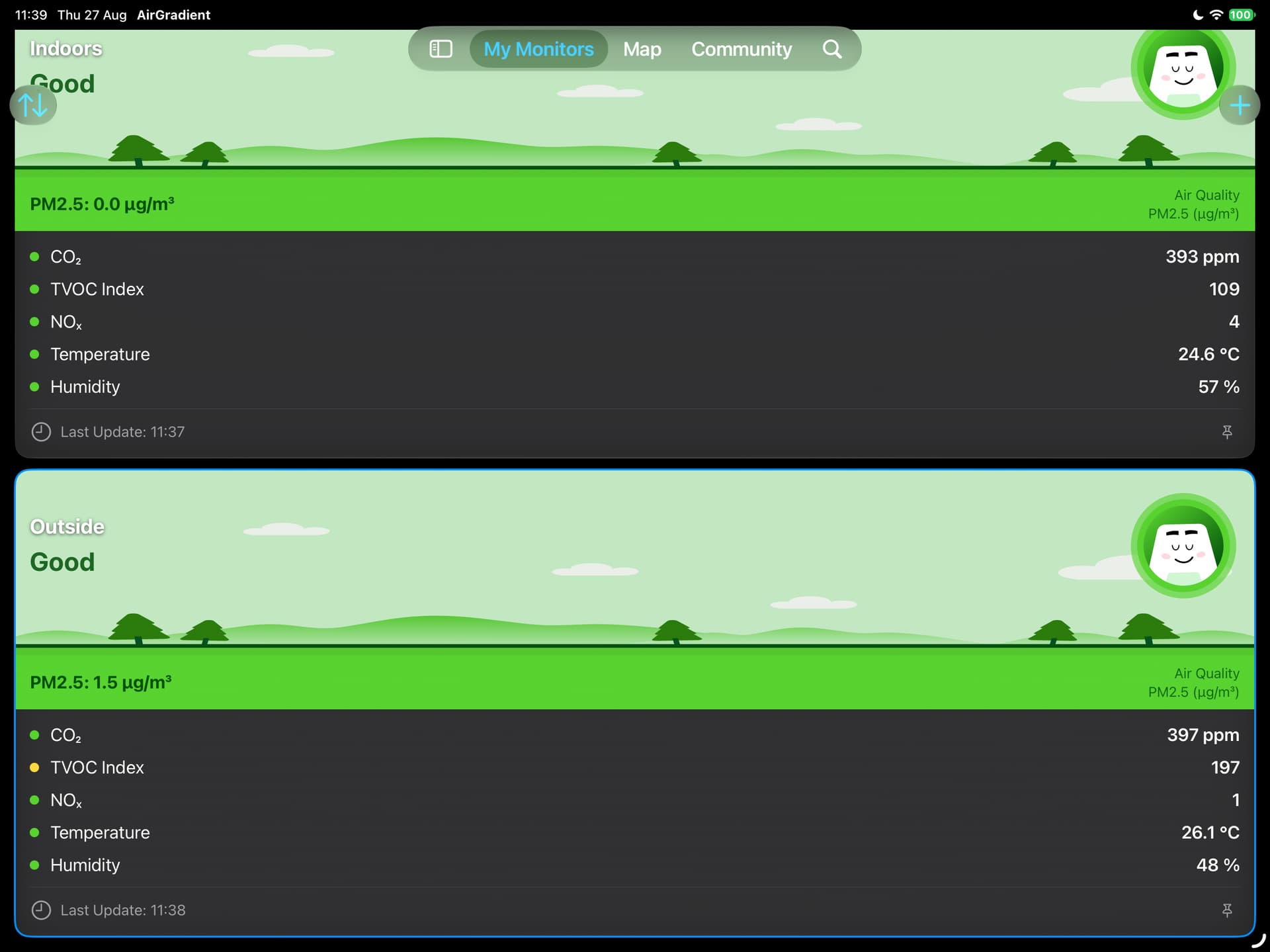
The CO2 readings differ the most. I would have hoped that CO2 would have some bearing in reality, but it seems the calibration process is just “find the lowest over a period of some days and call that 400”. Very disappointed in that.
From doing a bit of research on this, I think you would then be disappointed in any CO2 monitor on the market since they all appear to make the same assumption about atmospheric CO2 level being 400 ppm as they calibrate to your local conditions. The documentation of the calibration process can be located on the website of the company that produced the CO2 sensor used in the device. Look for the datasheet. There will be a description of the process employed and the reasons for that process.
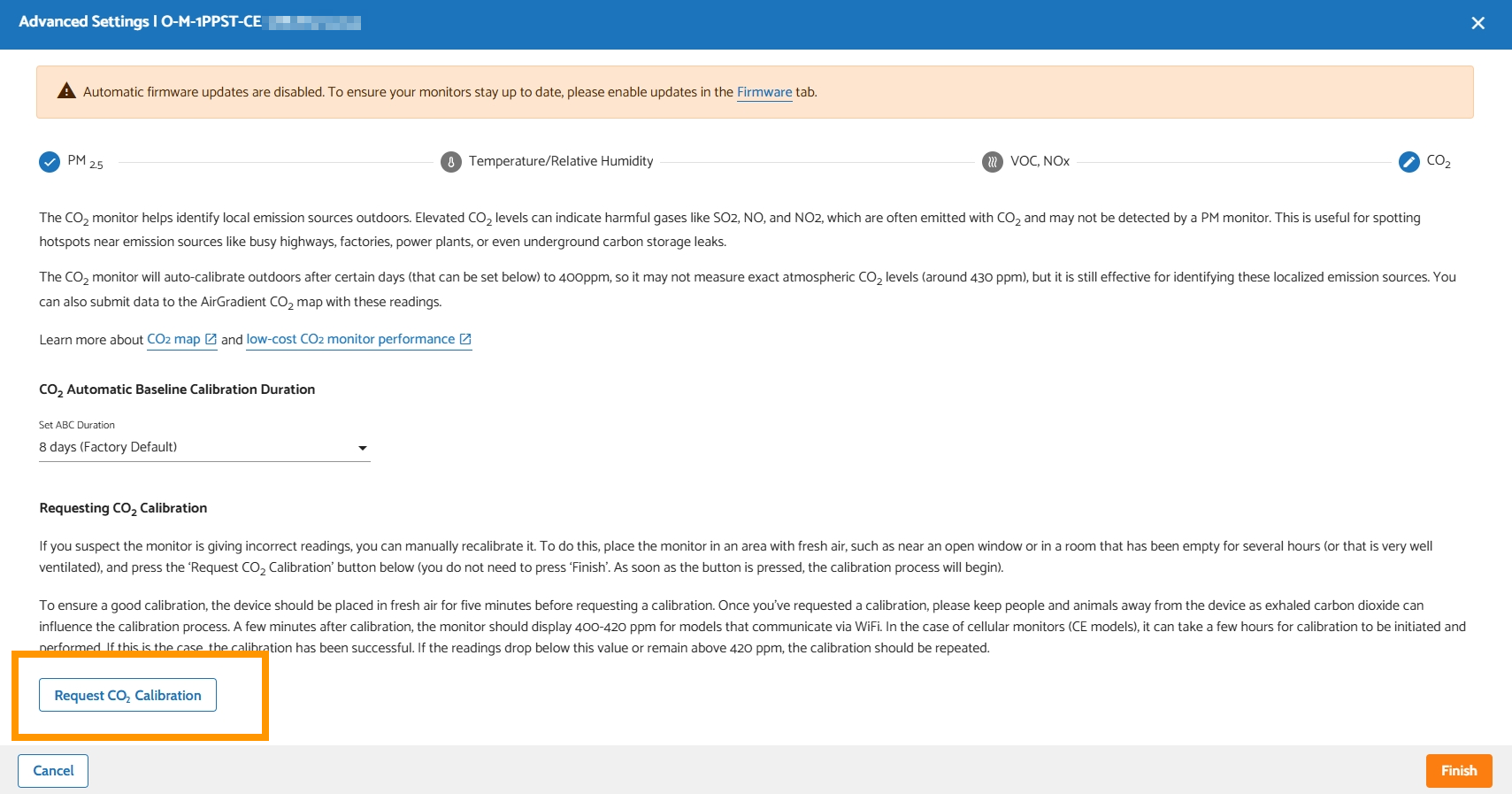
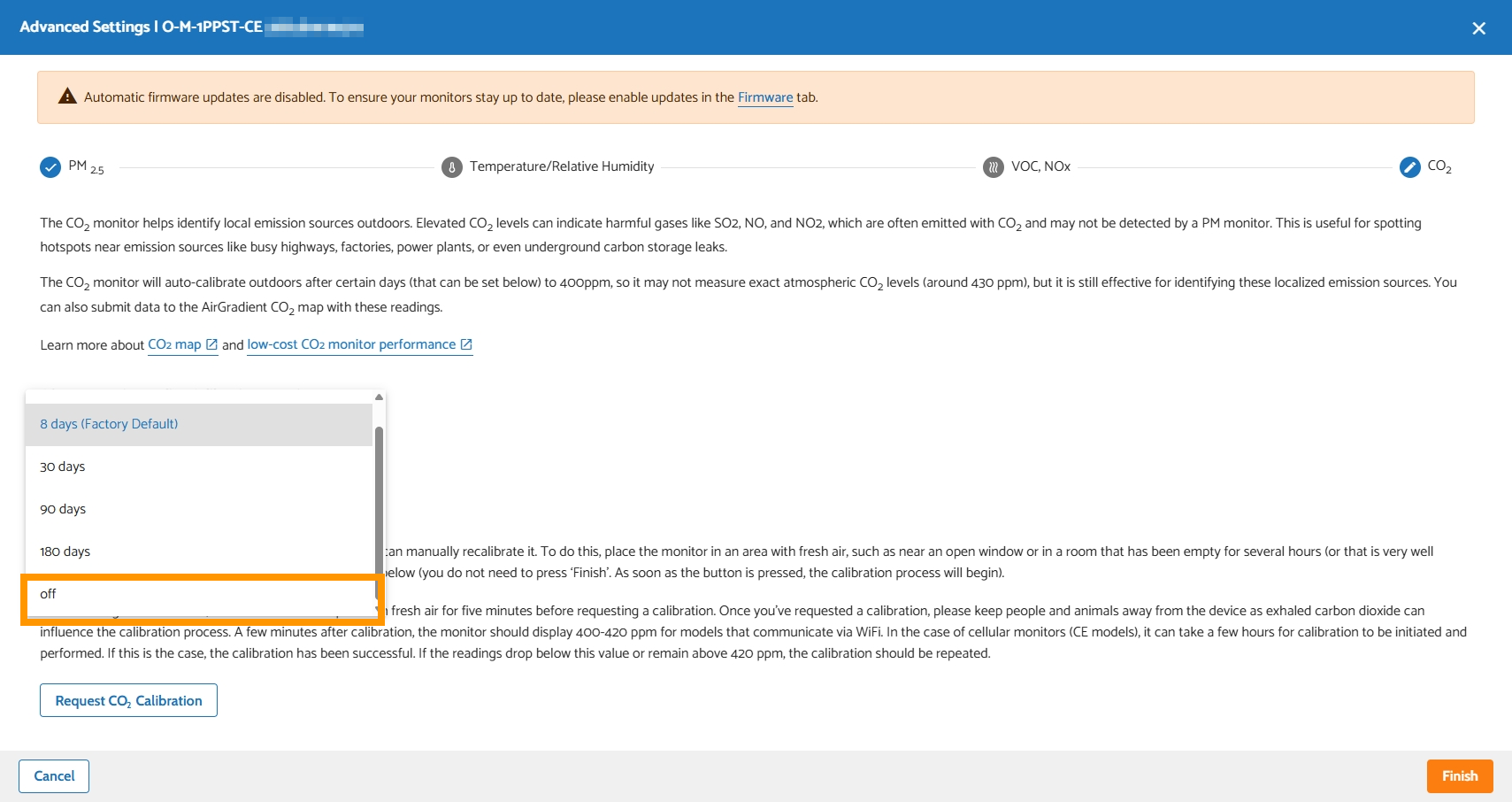
I believe that if you calibrate both sensors as Tai has recommended then those values should be much closer. Since sensor drift is a real issue it may be necessary to repeat that process in the future.
The temperature/humidity reported by the two devices may differ, even when they are side-by-side. This occurs partly because, in spite of their close proximity, they are not sampling the exact same volume of air. The main reason that they can or will be slightly different is related to their (T/H sensor) placement within the PM sensor where they are used to improve the PM sensing process.
Once again, if you read the datasheet on the sensor manufacturer’s site you will find a note that the temperature/humidity sensors may not report actual ambient air temperatures and will require a correction to be applied in order to report a temperature/humidity close to ambient air temperature/humidity. This is not a defect.
In addition, there are documents posted here on Air Gradient’s site which clearly document the decision process behind reporting the temperature/humidity values and the corrections applied to those measured values by the correction algorithm. Air Gradient knew from the manufacturer datasheet that the temperature and humidity sensors were not weather-station grade measurements due to their position inside the PM sensor where their measurements would inevitably be affected by heat generated during the PM measurement process and by heat radiated from other system components including the WiFi sensor.
For that reason, once it became obvious that some users would like to access the temperature/humidity data on their dashboards, Air Gradient accumulated sensor data under varying conditions from sites scattered globally and developed calibration algorithms that under most conditions should closely approximate local temperature and humidity data. Those data are not as useful as data collected by a properly-placed, shaded sensor installed at recommended height above terrain. As mentioned, they are close but not equal because, as the manufacturer notes in their documentation, those sensors are not designed to be used as or to substitute for weather station quality sensors for the reasons that I noted above and that Achim and others have documented in several posts on this forum over the last couple of years.
The funny part of all this temperature/humidity discussion, at least to me is that Air Gradient openly documents their process and components and the reasons why things happen. In walking thru documentation for other commercial products I have found that most using the same sensors will not describe how these sensors are calibrated. They will however pass on the information from the manufacturer that temperature and humidity data will not match ambient air data measured by dedicated weather sensors due to the design of the PM sensor package that encloses the T/H sensors. Air Gradient is and has been open about the shortcomings of the T/H sensor when people attempt to use them to track local weather conditions. They have also documented their process behind deriving corrections to improve the T/H data so that it more closely matches ambient data. There should be some attaboys at the very least.
For you to have weather station quality temperature and humidity data your temperature and humidity sensors should be installed outside the Air Gradient enclosure with proper shielding from the sun using a quality shield that promotes air flow past the sensors. This is true whether you have an inside Air Gradient unit or an outside or portable Air Gradient unit. If you require exact, accurate temperature and humidity data then you need to acquire weather station type sensors available from many sources and let those stand in for your local environmental data. The Air Gradient sensor packages are designed to deliver accurate air quality data, especially particulate data and they employ highly accurate sensors to accomplish that goal.
Your TVOC and NOx data will also be a true local measurement with quality dependent on your placement of the sensor package and its proximity to sources of VOCs and NOx. They are non-discriminatory sensors that can not identify specific components in the air they sample though they do provide accurate air quality data by tracking the changes in TVOC/NOx at their install site. As you walk along with your Go package it will likely fluctuate a lot in TVOC/NOx and the likelihood that it ever matches readings from your inside AG package are pretty slim since they sample different air volumes routinely.
I’m still looking into all this and will, in time, have more to say. I just wanted to jump in here and spew all the things I have found about these sensors.
I own one O-1PST sensor package installed on my property and in use for more than 18 months. This post is entirely my own opinion based on my own research. I posted today to help /u/mogul and other AG owners understand the values that their sensor packages are reporting.