AirGradient Forum

A problem with Airgradient Map

I really appreciate AirGradient Map because it allows you to see air quality in real time and zooming in from a larger scale to a local one.
Looking at my City I noticed that some sensors were systematically way off both from nearby sensors and other reliable data or forecasts.
In the picture below there is such an example: the circled sensor has a PM2.5 measured value of 5 (micrograms per metric cube) while others in the city are in the 20 range. I took a look to the last month average of that sensor and it was 6.9 (micrograms per metric cube) while an enviromental monitoring staton placed 3.5km from tthe sensor has a monthly average of 28.7. So I’m pretty confident the figures reported from the circled sensor are roughly 25% of validated data from reference instruments of the local enviromental agency.
Now if we zoom out we’ll see an average where 2 sensor vastly underestimate PM2.5 and this will give a wrong value for the entire city.
I think this is not easy to fix, but validating sensors on the map with reliable reference data could improve very much the reliability of the data displayed on the map.
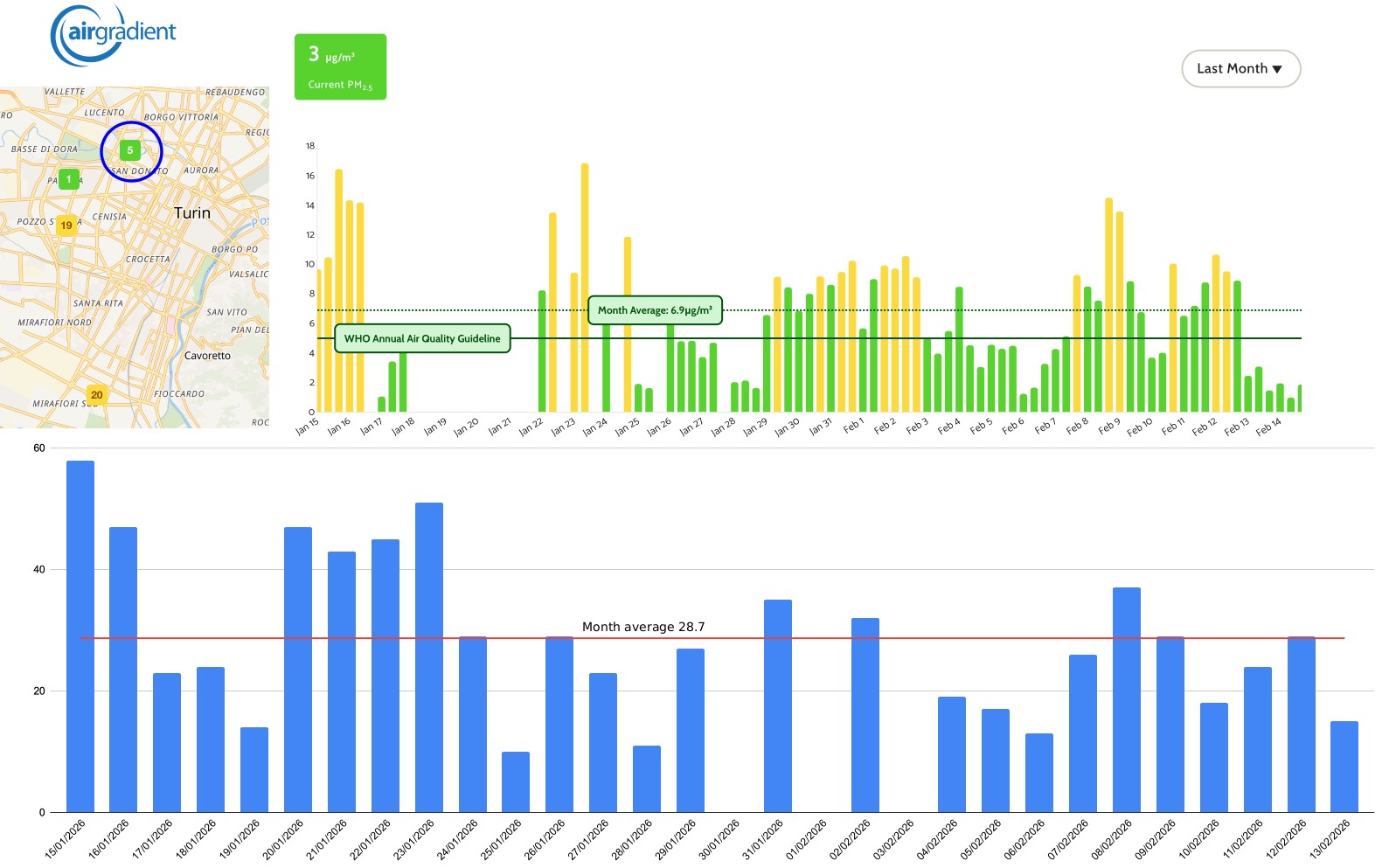
The data in the blue bar chart below was downloaded from the Regional Environment Protection Agency (ARPA Aria | Arpa Piemonte )
@gianfranco.bottini

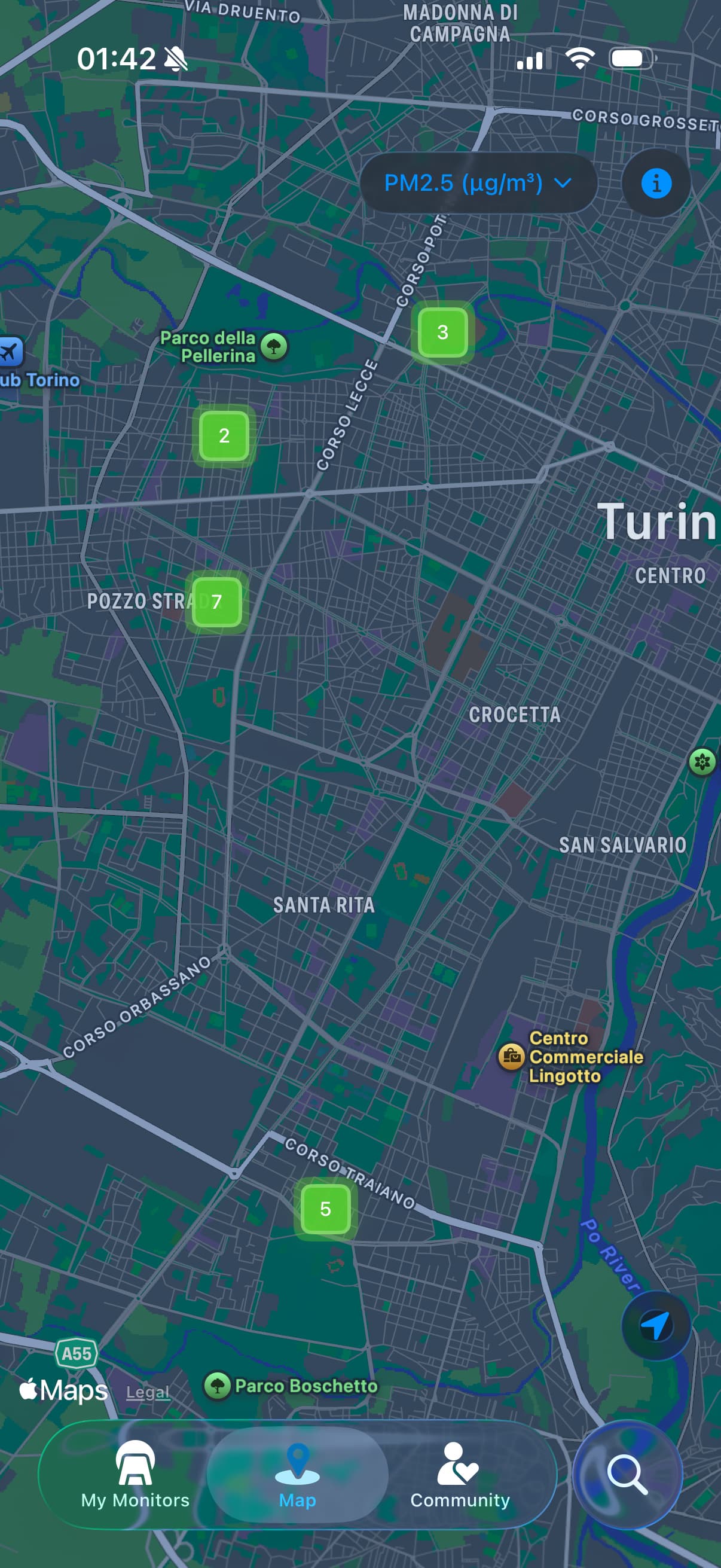
I just checked Turin and right now the numbers are much closer.


(From our iOS app)

However, you are raising an important point because there are a few fundamental challenges.

  1. Data from different sensor network.
    The two more northern points are sensors from sensor.community which uses a different PM sensor than what we have at Airgradient. Sometimes these seem to be lower than they should be. We are looking into potentially applying a calibration onto them.

  2. Time offsets.
    Some of the data we pull in eg for reference stations can be 1-2 hours old. This is directly compared to real time data from AirGradient monitors. Sometimes we see big swings throughout the day and just a difference of a few hours can make a big difference.

  3. Averaging
    Some sensor networks we pull in apply 24h moving averages to their data. This makes them much less dynamic and can also lead to considerable differences when air quality changes.

We already apply outlier detection on the map and hide clearly wrong data points but as you can see with the current screenshot, and above background information it becomes quite difficult to have a 100% reliable algorithm.

Having said that, we are extremely interested to improve this further as we will start using that data more and more in analysis and reports.

1 Like

@Achim_AirGradient

Indeed, in these days, we are experiencing unusually strong winds and thus the air quality is unusually good. Turin is in the Po Valley, which is one of the most polluted areas in Europe for fine particulate matter (PM10, PM2.5), especially from November to February, due to adverse weather conditions (temperature inversion, lack of wind) and the high concentration of emissions from traffic, industry, and heating. The bowl-shaped orographic configuration, surrounded by the Alps and Apennines, prevents the dispersion of pollutants.

I’m sure it’s very difficult to identify all wrong data points. I think since you put much emphasis on community, maybe some kind of feedback from the map users may be integrated in the algorithm.

I’m really glad there was another AirGradient open air, and after a while I desired to buy one, and share its data, but I understand that part of the work is also making sure there is good data available for public use and research, so I finally decided to post this topic.

Yes we are planning to implement a feedback button to enable community members to report monitors they think are wrong.

1 Like

That’s great news, I think it will improve the data quality. Thank you for your outstanding work! :clap: